✅ Mens Kilt Outfit – Frequently Asked Questions
Yes. Mens Kilt Outfit is a UK-based company.
No, we do not operate a physical retail store.
We are an online kilt brand, delivering worldwide.
Returns and exchanges are very simple.
If an item is defective or you want an exchange, we will provide you the nearest manufacturing unit address (UK, USA, or Pakistan) via email or WhatsApp.
You can send the item back easily, and once it is received, your replacement will be dispatched from the same manufacturing unit.
We have multiple manufacturing units located in:
- United Kingdom
- United States
- Pakistan
Your order is produced and dispatched from the nearest available unit.
Our mission is to make kilts a part of everyday fashion, not just traditional events.
We design:
- Lightweight kilts
- Fewer-pleat modern kilts
- Running kilts
- Swim kilts
- 5-yard kilts
- Short-length and long-length comfort options
Our goal is to help people proudly wear and share Scottish heritage worldwide with more comfort and style.
You can contact us anytime at:
+44 7362 699510
Sizing, Shipping, Orders & Custom Kilts
At Mens Kilt Outfit, we offer a wide range of custom kilts, including traditional Scottish tartan kilts, utility kilts, Hybrid, Leather, Lightweight and custom-made kilts. Our selection is designed to suit various occasions, from casual wear to formal events.
We provide a detailed size guide on each product page to help you select the correct size. Please measure your waist at the belly button level for the most accurate fit, as kilt sizes differ from regular pant sizes.
Yes, once your order has been shipped, we will send you an email with tracking information. You can use the tracking number to monitor the status of your shipment.
To create an account, simply click on the “Sign Up” button at the top of the homepage. Follow the instructions to register, and all your details will be saved for future purchases.
We accept all major credit cards, PayPal, and other secure payment gateways to ensure a smooth and safe transaction.
Yes, you may cancel orders for “Ready-Made” items before you receive a shipping notification. To cancel, please call our store at +923703556582, or or email us at support@menskiltoutfit.com.
Orders for “Custom” items, indicated by the product page icon (e.g., tartan products, custom-made jackets, clan crest items, etc.), cannot be canceled once the product has left our supplier.
We offer two shipping options to match your needs:
- Rush Order: Delivered within 6 working days
- Regular Order: Delivered within 15 days
If any item in your order is not in stock, we’ll notify you within 24 hours of your purchase and provide an updated estimated delivery date.
Yes, Mens Kilt Outfit ships worldwide, including Europe and the rest of the world. No matter where you are, we’re committed to delivering your custom kilts with care.
Have questions? Need help?
Reach out anytime at support@menskiltoutfit.com — we’re always here to assist you.
We offer a VAT-paid delivery service to Europe via our Belfast dispatch option. With this service, there are no additional customs duties or VAT charges for the customer—your parcel will arrive without any extra fees. However, this method typically takes around 15 days for delivery.
If you choose express shipping through DHL, FedEx, or UPS, the parcel will be shipped directly, but custom duties and taxes may apply upon arrival.
Yes, we deliver to remote areas. However, if your address is classified as a remote location by our shipping partners, direct delivery may not be available.
In such cases, we arrange shipment through multiple courier partners to ensure your package reaches you safely. This may slightly increase the delivery time, but you will not be charged any additional shipping fees.
Estimated Transit Time for Remote Areas: 10–12 Business Days
Normal Transit Time: 5–7 Business Days
Remote Area & Rush Orders
If you place a Rush Order and your address falls in a remote area, expedited delivery may not be possible. While we prioritize rush orders in production, courier limitations in remote locations can still extend the overall delivery time.
Many kilt makers cancel remote-area orders because delivery deadlines cannot be guaranteed and special courier arrangements often involve significantly higher shipping costs. At Mens Kilt Outfit, we do not cancel such orders. Instead, we arrange specialized shipping solutions and cover the additional courier costs whenever necessary.
Note:
Even for Rush Orders, remote-area deliveries may require extra transit time. We kindly ask for your patience and cooperation, and we will do our best to dispatch and deliver your order as quickly as possible.
Rush Orders are normally expected to be delivered within approximately 10 days. However, if your shipping address is located in a remote delivery area, direct courier service may not be available, and the standard Rush Order timeframe may therefore not be possible.
In this situation, Mens Kilt Outfit will arrange the delivery on your behalf through two courier partners. The additional courier service is required because of the remote location, and we will cover the extra delivery cost ourselves. You will not be charged any additional remote-area shipping fee and you do not need to arrange or pay for the second courier.
Please note that while we will prioritize your Rush Order and make every effort to deliver it as quickly as possible, delivery within the standard 10-day Rush timeframe cannot be guaranteed for remote-area addresses. The shipment may require additional transit time due to the two-courier delivery process.
In short: We take care of the additional courier arrangement and cost for you; you simply need to allow some additional time for your order to reach your remote-area address.
Yes, our website is open 24/7, allowing you to browse and place orders at your convenience, no matter the time of day.
Email: support@menskiltoutfit.com
WhatsApp: +44 7362 699510
Yes. If your kilt arrives with any defect, size issue, or stitching problem, we fix or replace it without any extra cost.
Your satisfaction is our priority.
Yes. We use authentic tartan patterns, including clan tartans, modern tartans, and traditional Scottish patterns sourced from trusted mills.
We use premium-quality materials such as:
- Acrylic wool (16 Oz Premium Quality)
- Premium wool (upgrade option)
- Leather
- Lightweight cotton blends
- Polyester-viscose blends
Fabric varies per category — listed clearly on each product page.
Yes. If your clan tartan or color is not listed, simply contact us.
We can source many tartans upon request.
Yes. We provide all sizes, from small to big & tall.
Waist sizes from 25″ to 70″+ and lengths from 17″ to 36″ are available.
Yes, we can create custom kilts for children with accurate measurements.
Yes. We offer kilts for:
Fashion and modern styling
Weddings
Formal events
Highland games
Sports and running
Daily wear
Our kilts are built for long-term use.
Pleats are reinforced, and stitching is strengthened for daily wear, athletics, and outdoor activity.
No. We use fade-resistant materials.
Proper care ensures long-lasting color and fabric quality.
Yes. You can pair your kilt with:
Fly plaids
Sporrans
Belts & buckles
Kilt pins
Jackets & waistcoats
Kilt hose
Brogues
Sashes
Select our Rush Order option for priority production and fastest delivery (7-10 Day Delivery.
No. We never store customer payment details.
Payments are processed securely through encrypted gateways.
Yes. We follow strict GDPR and data privacy standards.
Your information is never shared or sold.
Yes, if the order has not been shipped yet.
Contact our support team immediately.
Yes. We offer ladies’ kilts, sashes, and custom tartan accessories upon request.
Why Choose Our Kilts Over Cheap Alternatives?
Most $49 kilts are made with lightweight fabrics (around 9oz–12oz), which look similar at first but don’t last. We use heavyweight 14oz to 16oz acrylic wool or tartan wool blend, designed for authentic drape, durability, and comfort. Our kilts are crafted to last for years, not just one-time wear.
No. We keep our shipping fair and transparent. Some kilt maker may show a low product price but then add $50–$99 in delivery. With us, what you see is what you get—no hidden surprises at checkout.
Absolutely. Our premium kilts are tailored for weddings, Highland games, cosplay, and formal wear. Cheap kilts can wrinkle or lose their shape, but ours maintain a structured look with strong pleats and quality stitching.
Yes. Unlike many low-cost sellers, we provide custom waist, length, and tartan options. Each kilt is made to your fit, not just a generic size chart.
A big difference. Our fabrics are thicker, softer, and closer to traditional wool feel. Cheap kilts often feel stiff, synthetic, or scratchy. Our kilts balance durability with real comfort.
No, never. Even for our lightweight or casual-style kilts, we use the same high-quality tartan fabric (14oz to 16oz) as our premium kilts. To reduce the weight slightly, our skilled kilt makers use fewer pleats—without compromising the traditional look and feel. You still get the same durability, structure, and authentic style, just in a lighter design.
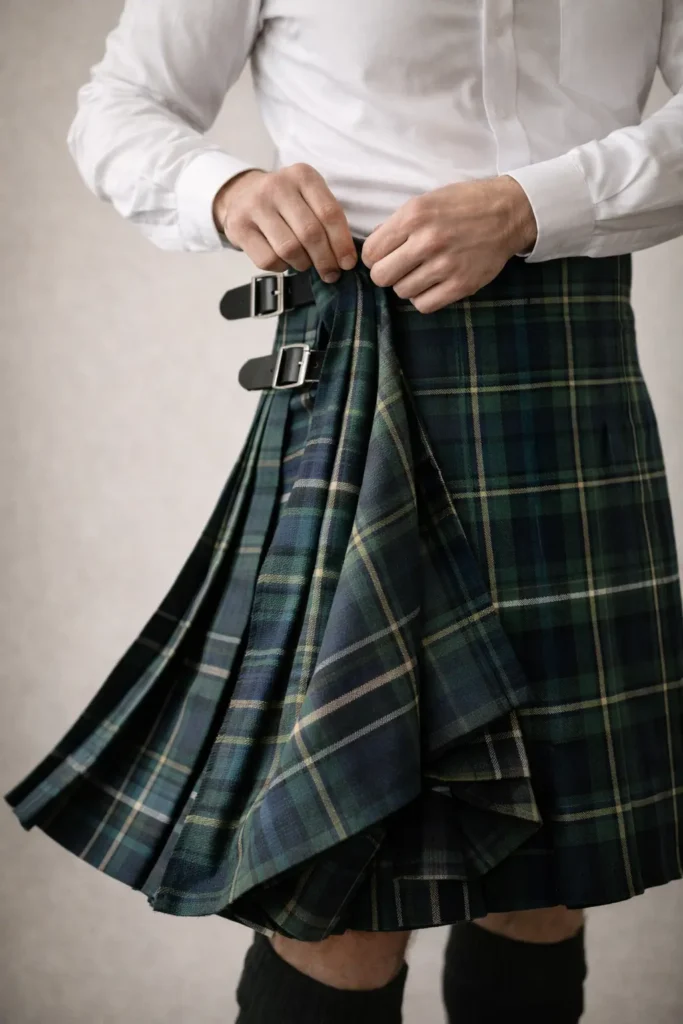
A kilt should be worn higher on the waist than regular trousers, usually around the belly button. The pleats should fall at the back, and the flat apron panels should be at the front. Fasten the straps snugly for a secure but comfortable fit, and pair your kilt with appropriate accessories like a sporran, belt, and hose for a complete look.
A belt or sporran is not mandatory, but it is highly recommended for a traditional appearance and added functionality. Sporrans provide storage, while belts enhance the overall fit and style. Utility kilts can also be worn comfortably without accessories for a casual look.
All our kilts are made from high-quality acrylic wool fabric. This material offers the classic tartan appearance of traditional wool while being more durable, lightweight, and easier to maintain. Acrylic wool is ideal for everyday wear, events, and long-term use.
Yes. Acrylic wool kilts are designed for comfort and practicality. The fabric is breathable, holds pleats well, and feels comfortable against the skin, making it suitable for extended wear during weddings, festivals, outdoor events, and casual use.
Acrylic wool kilts are easy to care for. We recommend gentle washing in cold water using mild detergent. Avoid high heat and tumble drying. Hang the kilt to dry and lightly iron on low heat if needed to maintain the pleats.
Yes, acrylic wool kilts can be machine washed on a gentle cycle with cold water. For best results, turn the kilt inside out and avoid harsh detergents or bleach. Air drying is recommended to preserve fabric quality and pleats.
To keep pleats sharp, store your kilt hanging properly after wear. Light ironing on low heat can be used if necessary. Acrylic wool holds pleats better than many natural fabrics, making it ideal for regular use.
To keep pleats sharp, store your kilt hanging properly after wear. Light ironing on low heat can be used if necessary. Acrylic wool holds pleats better than many natural fabrics, making it ideal for regular use.
In rare cases of delays, our team will notify you via email. You may also contact us directly for updates, and we will assist you with the latest delivery information.
Frequently Asked Questions About Kilts
Men wear kilts for both historical and cultural reasons. Originally, the kilt was a highly practical garment for men living and working in the Scottish Highlands. It offered warmth, allowed complete freedom of movement, and could double as a blanket or cloak — advantages that trousers, which were restrictive and less suited to rugged terrain, could not provide. Culturally, the kilt became a symbol of clan identity (with each tartan representing a family or regiment) and later of Scottish national pride — especially after the British Crown banned kilts in 1746, turning them into a symbol of defiance. Today, men wear kilts to honour their heritage, at formal occasions, and increasingly as a global fashion statement.
Yes, Irish people do wear kilts — but the Irish kilt tradition is entirely different from the Scottish one, and it is far more recent. Historically, the traditional Irish garment was the léine, a long saffron-dyed linen tunic, not a kilt. Ireland’s connection to kilts developed during the Celtic Revival of the late 19th and early 20th centuries, when the kilt was adopted as a symbol of Gaelic pride and cultural identity. The modern Irish kilt is most commonly worn in solid colours — particularly saffron yellow or green — rather than the clan tartan patterns associated with Scotland. Today, Irish kilts are worn at weddings, St. Patrick’s Day parades, pipe band performances, and cultural festivals. They are not common in everyday Irish life.
Kilts are primarily Scottish in origin. The earliest written record of the great kilt (féileadh mòr) in Scotland dates to 1594, and the modern tailored kilt emerged in the early 18th century. Ireland adopted the kilt approximately 100 years ago during the Celtic Revival, making it a relatively recent tradition in Ireland. Both countries now have their own distinct kilt styles: Scottish kilts feature clan tartan patterns, while Irish kilts typically use solid colours or county-based tartans designed in 1996. So while kilts are not exclusively Scottish, their origins and deeper history are Scottish.
Scottish men wear kilts for three core reasons. First, cultural pride: after the British Crown banned kilts and tartan under the Dress Act of 1746 (following the Jacobite uprising), Scots wore them in defiance. The ban lasted 36 years and turned the kilt into a powerful symbol of Scottish resistance and identity. Second, clan identity: each tartan pattern represents a specific Scottish clan, so wearing a kilt is a way of declaring family heritage and loyalty. Third, historical practicality: the original great kilt was ideal for the rugged Highland terrain — it was warm, allowed freedom of movement, and doubled as a blanket or cloak. Today, kilts are worn at weddings, Burns Night suppers, Highland Games, graduations, and military parades.
Kilts are most closely associated with Scotland, where they have been worn since the 16th century. Ireland also has its own kilt tradition, worn at cultural and ceremonial events. Beyond these two countries, kilts are worn by Scottish diaspora communities worldwide — particularly in Canada, the United States, Australia, and New Zealand — at Highland Games, Tartan Day events, and family celebrations. In the modern era, kilts have also entered mainstream global fashion, worn by men and women of all backgrounds as a cultural or fashion statement.
Yes, women wear kilts. While the kilt has historically been associated with Scottish men, women have worn kilt-like garments in Celtic culture for centuries — including the léine, a long tunic, and the earasaid, a tartan wrap draped over the shoulder. In the late 19th century, women began wearing tartan kilted skirts for formal occasions. Today, kilts are considered unisex. Women wear full kilts, kilted skirts, and tartan wraps at weddings, Highland Games, ceilidhs, pipe band performances, and as everyday fashion. Princess Diana famously wore kilts during visits to Scotland, helping to popularise them for women internationally.
No — Vikings did not wear kilts. The Viking Age ran from approximately 793 to 1066 AD, but the earliest documented evidence of the Scottish great kilt dates to 1594 — more than 500 years after the Viking Age had ended. Viking men wore fitted trousers, knee-length wool tunics, and cloaks fastened with brooches. Archaeological evidence from Viking burial sites across Scandinavia confirms this. There is no historical or archaeological record of Vikings wearing any garment resembling a kilt. This misconception is largely the result of TV shows, films, and video games taking creative liberties with historical accuracy. However, Viking settlers in Scotland may have had an indirect influence on the early development of Scottish Highland dress.
This is one of the most commonly asked questions about kilts, and the honest answer is: it is a matter of personal choice. The tradition of wearing nothing underneath a kilt — sometimes called ‘going regimental’ or ‘true Scotsman’ — originates from Scottish military regiments, where soldiers wore kilts without underwear. This practice became part of Scottish cultural folklore. In formal military ceremonies, some Highland regiments still follow this tradition. However, in everyday and civilian life, most modern kilt wearers wear whatever they find comfortable underneath. There is no rule that requires or forbids either choice.
The great kilt (féileadh mòr) — the earliest form of the kilt — is first definitively described in a written source from 1594 in Scotland. It was a large single piece of woollen cloth, roughly 4 to 6 metres in length, pleated and belted at the waist, with the upper portion draped over the shoulder or used as a hood. The modern small kilt (féileadh beag) — the knee-length tailored version worn today — developed in the late 17th or early 18th century. According to a widely cited account from 1768, an Englishman named Thomas Rawlinson, working in the Scottish Highlands in the 1720s, is credited with creating the tailored small kilt. The kilt became a national symbol for all of Scotland after King George IV’s visit to Edinburgh in 1822.
Yes, Irish men do wear kilts, primarily on formal and cultural occasions. These include weddings, St. Patrick’s Day events, pipe band performances, Irish dance competitions, and military parades. The Irish kilt differs from the Scottish kilt: it is most commonly worn in solid colours such as saffron yellow or green, rather than tartan patterns. Ireland does not use clan tartans. Instead, Irish County Tartans — one for each county in Ireland — were designed in 1996 by the House of Edgar and are used to represent regional heritage. Kilts are not worn in everyday life in Ireland; they are reserved for ceremonial and celebratory occasions.
Kilts are worn in Ireland, but they are not part of everyday dress. The Irish kilt tradition is approximately 100 years old, originating during the Celtic Revival of the late 19th and early 20th centuries, when the kilt was adopted as a symbol of Irish and Gaelic cultural identity. In Ireland today, kilts are most visible at weddings, national celebrations, pipe band competitions, and cultural festivals. They are not a common sight in daily Irish life. Irish kilts are characteristically different from Scottish kilts — they tend to be solid-coloured (saffron is most traditional) rather than tartan-patterned.
Irish pipe bands do sometimes wear kilts while performing, although this is not a deeply rooted ancient tradition. Irish bagpipes (called uilleann pipes) are a distinct instrument from Scottish Highland bagpipes, and the association between pipes and kilts in Ireland is a relatively modern one, tied to the Celtic Revival. Today, many Irish pipe bands wear kilts as part of their performance uniform — often in saffron or green — as a visual expression of Celtic cultural heritage.
Shipping and returns made easy.
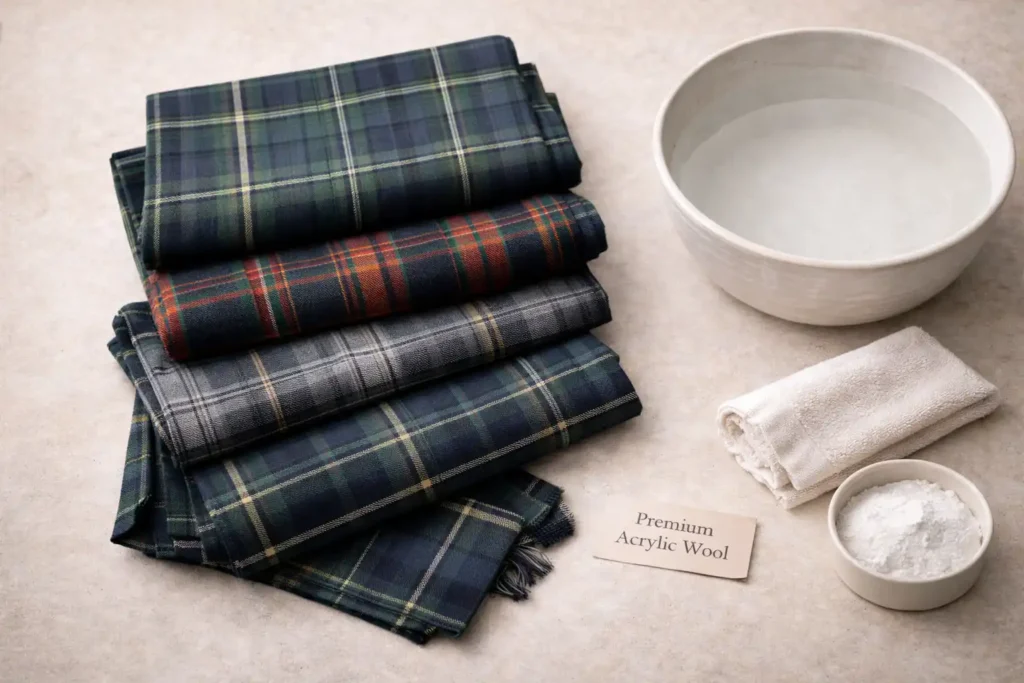
Premium acrylic wool fabric — durable, easy to care for, and designed for everyday wear.
How To Wear and Fit Your Kilt Correctly
A kilt should be worn higher on the waist than regular trousers, sitting comfortably around the natural waistline — typically near the belly button, not on the hips. This higher placement ensures the kilt hangs correctly and provides proper balance and comfort.
To put on your kilt, wrap it around your waist so that the flat apron panels are positioned at the front and the pleated section falls evenly at the back. Secure the straps firmly but comfortably; the kilt should feel snug without restricting movement. A properly fitted kilt will stay in place without slipping or feeling tight.
The length of the kilt is also important. When fitted correctly, the bottom edge of the kilt should fall at the center of the knee, allowing ease of movement while maintaining a traditional and polished appearance.
Accessories complete the fit and function of a kilt. A sporran is commonly worn at the front to provide storage and balance, while a belt adds structure and enhances the overall look, especially for traditional or formal outfits. Utility and casual kilts can also be worn without accessories for a relaxed style.
When worn and fitted correctly, a kilt should feel secure, comfortable, and natural — allowing you to move freely while maintaining a confident and authentic appearance.