Premium Tartan Wedding Kilts
Original price was: $199.$89Current price is: $89.Premium Tartan Wedding Kilts
A wedding is one of those rare days when every little detail matters—right down to what you wear. And if you’re looking for something that feels timeless yet deeply personal, a wedding kilt might be exactly right. There’s something about the way a Scottish wedding kilt carries history and pride that a regular suit just can’t quite match.
Choosing a Scottish wedding kilt isn’t just about picking a color you like. It’s more about finding a tartan that feels meaningful—or at least one that looks and feels amazing for your big day. Some couples stick with traditional family tartans, while others, honestly, just pick something that photographs well. Either way is fine. There’s no hard rule.
Maybe you want a lightweight kilt for a summer ceremony. Or maybe you prefer the heavier, more traditional wool that has a bit of weight to it—it depends. Comfort matters just as much as style, especially when you’re wearing it for hours (and dancing, hopefully).
Wearing a wedding kilt isn’t only about tradition. It’s about standing out without trying too hard. About feeling like yourself, but a little more… elevated, maybe. Plus, there’s just something unforgettable about the way a full kilt outfit looks in wedding photos. Honestly, you might even be surprised how many people will compliment it.
Take your time, though. Finding the right kilt is part of the experience. And it should feel just right.
Showing the single result
Premium Tartan Wedding Kilts
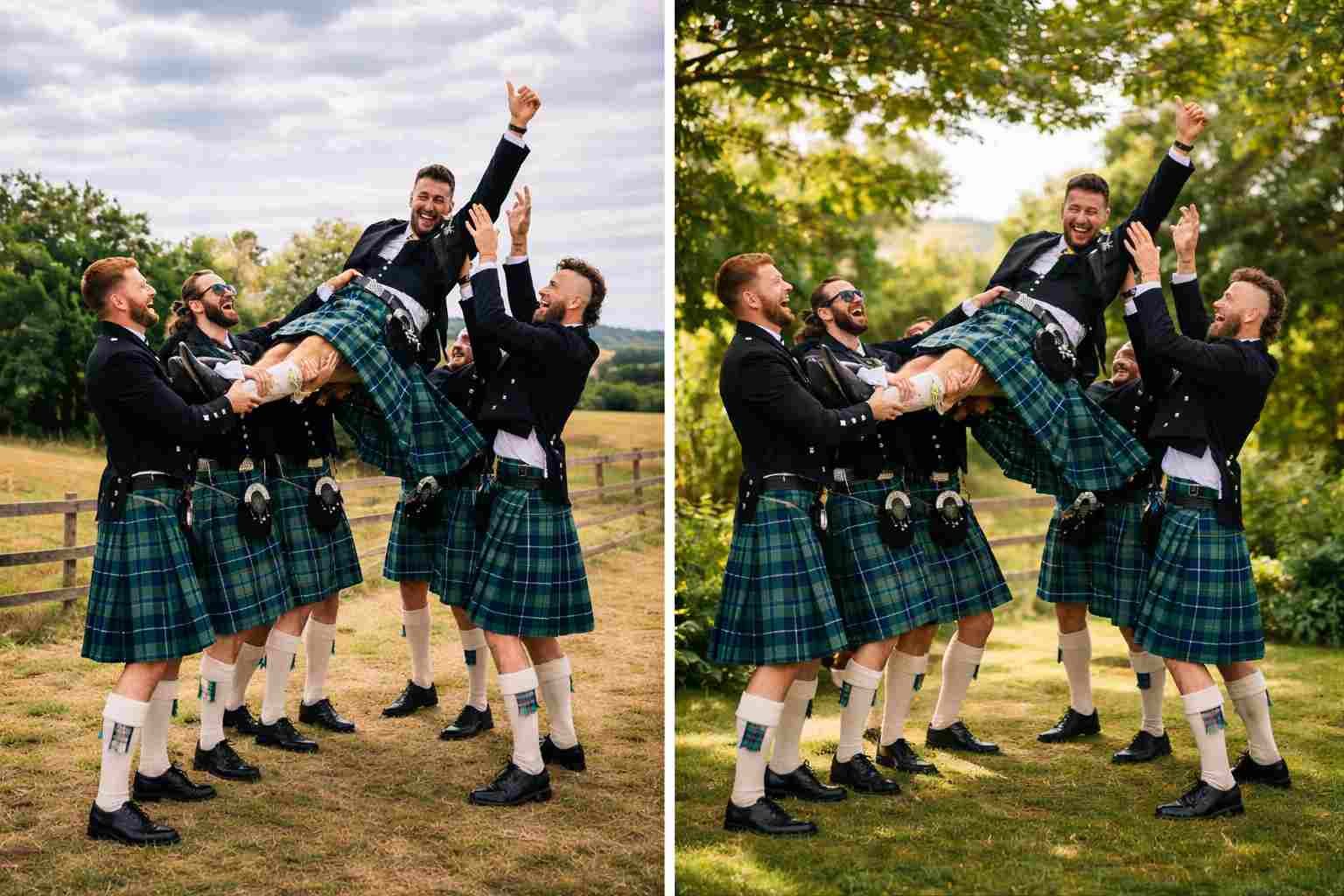
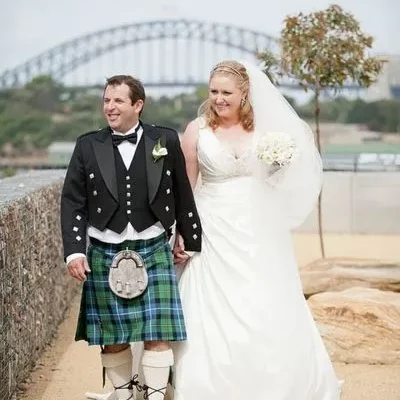
Traditional tartan kilts with a Prince Charlie jacket are the most formal and popular choice.
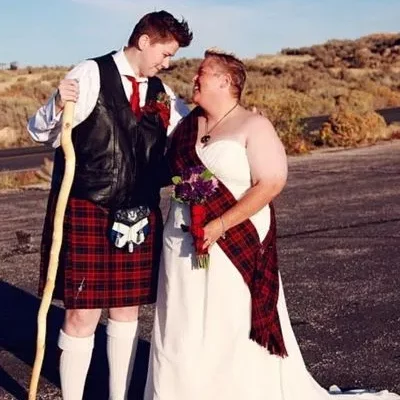
Yes, matching tartan kilts create a strong and cohesive wedding look.
Yes, complete packages including jackets, sporrans, and accessories are available.
Absolutely — many grooms choose their family tartan for added meaning.
Wore a full kilt outfit for my wedding. Honestly, it felt more special than a suit ever would.
Our whole group wore matching tartans — the photos turned out incredible.
Great fit, great quality, and everything arrived on time for the wedding.
A proper kilt attire wedding setup usually includes:
Some prefer the full traditional look. Others simplify it slightly. Both work.
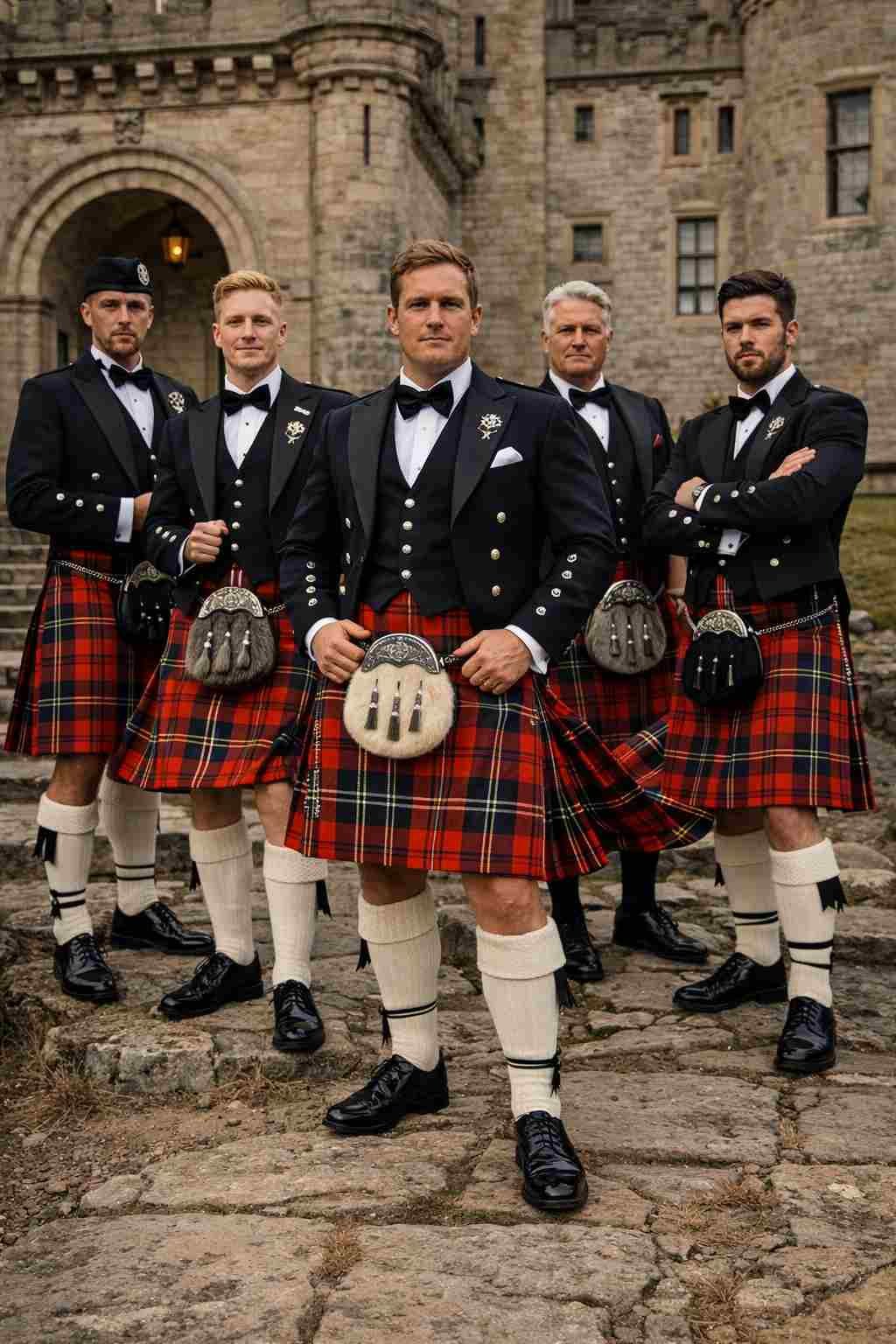
There’s something about a wedding kilt that doesn’t quite behave like other formalwear. It doesn’t just sit there and look good—it carries a bit of weight, history maybe, or just presence. I’ve noticed that when someone chooses a mens kilt wedding outfit, it’s rarely random. There’s usually a reason behind it, even if they don’t say it out loud.
Some grooms go for tradition. Others just want to stand out without looking like they tried too hard. And oddly enough, a formal kilt wedding look manages to do both at once.
When people think of a scottish wedding kilt, they often picture something very specific: tartan, sporran, jacket, the full arrangement. And yes, that’s part of it. But it’s not the whole story anymore.
Modern kilt attire wedding styles are a bit more flexible than people expect. You can still go full Highland—Prince Charlie jacket, waistcoat, flashes—but you can also tone it down. Some prefer a more understated black kilt wedding look, especially if the wedding leans formal or evening-focused.
I think that’s what makes it interesting. You’re not locked into one version of “correct.”
A groom in kilt tends to stand out—and not in an over-the-top way. It’s more subtle than that. The silhouette is different. The movement is different. Even the posture seems different, though that might just be perception.
Choosing a groom kilt or a full wedding kilt suit isn’t just about clothing. It shapes the entire look of the ceremony. Photographs, especially, end up feeling more textured, less predictable.
And yet, not every groom wants to go full traditional. Some prefer a kilt wedding suit with cleaner lines—less ornamentation, fewer accessories. Maybe just the kilt, jacket, and a well-fitted shirt. It works, surprisingly well.
The idea of tartan kilts for weddings is still very much alive. Clan tartans, universal tartans, even custom designs—there’s a lot to choose from. And honestly, it can feel a bit overwhelming at first.
Some couples coordinate tartans across the wedding party. Others deliberately don’t. I’ve seen weddings where the groom wears a deeply personal tartan, while the groomsmen wear something neutral. It creates contrast, which… I think works better than perfect matching sometimes.
But then again, matching has its own charm. It depends on the tone you’re aiming for.
If the event leans toward black-tie, dress kilts weddings are where things get refined. A proper formal kilt wedding setup—think Prince Charlie jacket, bow tie, polished shoes—can hold its own against any tuxedo.
Actually, in some settings, it might look better. Or at least more memorable.
For those who prefer darker tones, the black wedding kilt option is increasingly popular. It strips away some of the visual complexity of tartan while keeping the structure intact. Clean, sharp, and maybe a little more contemporary.
Still, there’s a part of me that thinks weddings are one of the few places where going a bit traditional doesn’t feel out of place.
While the Scottish roots are obvious, the irish kilt wedding trend has been quietly growing. Irish kilts often use solid colors or saffron tones, which give a different aesthetic—less patterned, more minimal.
It’s interesting how these styles overlap. You might see a wedding where elements from both traditions appear, and it doesn’t feel forced. Just… blended.
I suppose that’s what modern weddings tend to do anyway—pull from different places and make something personal out of it.
Picking from the range of men’s kilts for wedding occasions isn’t always straightforward. There are practical questions—fabric weight, pleating style, accessories—but also less tangible ones.
Like: does it feel right?
Some grooms try on a kilt and immediately know. Others hesitate. And that hesitation isn’t necessarily a bad thing. It just means they’re thinking about it, which probably leads to a better decision in the end.
A well-chosen wedding kilts for groom setup should feel comfortable, not just physically but visually. You shouldn’t feel like you’re wearing a costume. That’s the line most people try to avoid.
Accessories tend to make or break a kilt wedding suit. The sporran, flashes, belt, jacket style—they all add up.
But not everyone needs all of them.
Some of the best formal kilts for weddings I’ve seen were actually quite restrained. A simple sporran, minimal flashes, and a clean jacket. Nothing excessive.
Then again, there are weddings where going all-in feels right. It depends on the setting, the venue, even the weather.
When it comes to the full wedding party, coordination becomes a bit more complex. Do all the groomsmen wear the same mens kilt wedding outfit? Or does the groom stand apart?
There’s no single answer. Some prefer uniformity—it looks cohesive in photos, and it simplifies decisions. Others like variation, especially if different tartans have personal meaning.
I’ve seen both approaches work. Though, if I had to choose, I might lean slightly toward giving the groom a distinct edge. Just enough to be noticeable.
At the end of it all, a wedding kilt isn’t just about tradition, or style, or even symbolism—though it touches all three. It’s about choosing something that feels a bit more intentional than standard formalwear.
And maybe that’s why people keep coming back to it.
A formal kilt wedding look doesn’t try to blend in. But it doesn’t demand attention either. It sits somewhere in between—confident, but not loud.
Which, if you think about it, is probably exactly where a groom should be on his wedding day.
Choosing a wedding kilt sounds simple at first. Then you start looking—and suddenly there are dozens of tartans, jacket styles, accessories… it gets complicated quickly.
Most grooms don’t say this, but there’s usually a moment where they pause and think, “Am I overdoing this?”
Maybe. Maybe not.
Here’s what actually matters:
If you want tradition → go for tartan kilts for weddings
If you want a cleaner, modern look → a black kilt wedding works better
Neither is “more correct.” It’s more about the tone of your wedding.
A full formal kilt wedding outfit (Prince Charlie jacket, waistcoat) is ideal for:
For daytime weddings, a slightly relaxed kilt wedding suit often feels more natural.
This part gets ignored too often.
A groom kilt should feel secure, balanced, and easy to move in. If it feels stiff or awkward, it shows—especially in photos.
A proper kilt attire wedding setup usually includes more than just the kilt itself. Though, interestingly, many first-time buyers assume it’s just one piece.
A full wedding kilt suit often includes:
Not everyone uses all of these. And honestly, you don’t have to.
Some of the best dress kilts weddings looks are slightly simplified.
At a glance, a scottish wedding kilt and an irish kilt wedding outfit might look similar. But there are subtle differences.
Scottish kilts:
Irish kilts:
Neither is better—it depends on your background, or sometimes just your preference.
It’s not just about tradition anymore.
A lot of men choosing mens kilt wedding outfits today aren’t doing it for heritage—they’re doing it because it feels different.
And maybe that’s the point.
Also—and this might sound minor—it’s memorable.
Most people forget suits. They don’t forget a well-dressed groom kilt.
No products in the cart.