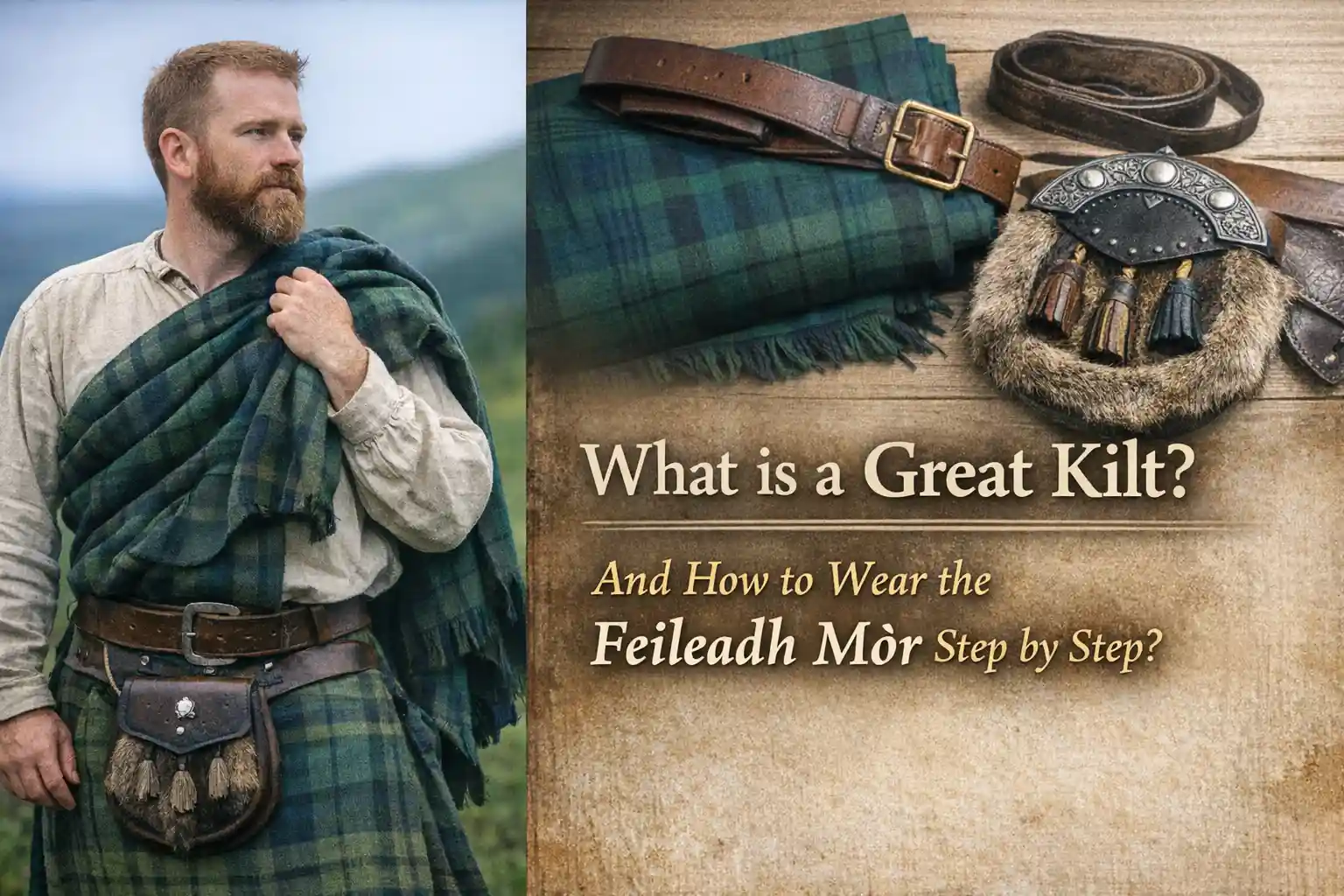
What Is a Great Kilt? And How To Wear The Féileadh Mòr Step By Step
If you’ve ever seen someone in a big sweep of tartan that looks half like a kilt and half like a cloak, you were probably looking at a Great Kilt—also called the féileadh mòr (often spelled feileadh mor) or the belted plaid.
And yes, it can feel a little intimidating. The first time I tried to put one on, I stood there staring at a huge piece of cloth like it was going to win the argument. It didn’t. I did. Eventually.
The good news is: once you understand what it is and why it’s shaped the way it is, the wrapping part becomes… not “easy,” exactly, but very doable. You’ll get a result that looks dramatic and old-world, and also surprisingly practical.
What is a Great Kilt (féileadh mòr)?
A Great Kilt is essentially a large length of tartan fabric—traditionally wool—worn pleated around the waist and belted, with the remaining fabric draped over the upper body like a cloak, shawl, or shoulder wrap.
So it’s not a “tailored garment” in the modern sense. There are no stitched pleats, no shaped waistband, no built-in fasteners. It’s more like wearable engineering: fold, pleat, wrap, belt, and then arrange the extra cloth on top.
Great Kilt vs Modern Kilt (Quick Difference)
A modern kilt is tailored and structured. It’s usually just the lower garment, with sewn pleats and a fitted waist. The Great Kilt is both:
- a lower kilt-like wrap, and
- an upper drape that can act like a cloak.
It’s basically the “full system,” which is part of why it looks so impressive… and part of why it can feel a little fussy.
Why People Still Wear It Today
People wear Great Kilts for historical reenactments, Highland events, weddings, photoshoots, festivals, and sometimes just because it feels powerful and a bit theatrical in a good way. And I think that’s fair. It’s hard to wear one and not stand a little taller, even if you’re quietly worried your pleats are drifting.
What You Need To Wear a Great Kilt
Before you start, gather your pieces. The Great Kilt itself is the main event, but a few extras make the whole thing stay put.
1) Great Kilt Fabric (Tartan)
- Traditionally wool tartan.
- Usually wide fabric (often around 54–60 inches wide).
- Length is commonly about 4–5 yards (some go longer, depending on height and how dramatic you want the drape).
A small note: heavier wool hangs beautifully and looks “correct” to many people. But… it’s also heavy. In warm weather, a lighter wool or wool blend can be more comfortable, even if it’s slightly less dramatic. I go back and forth on this myself.
2) A Strong Belt
This matters more than you think. The belt is what turns “big blanket” into “actual outfit.”
3) Optional But Helpful Accessories
- Kilt pin (usually for the outer apron area—more on placement later)
- Brooch or pin for securing the upper drape on the shoulder
- Sporran (traditional pouch worn front)
- Kilt hose and ghillie brogues (optional, but they complete the look)
- A simple shirt, tunic, or jacket
How To Wear a Great Kilt (Féileadh Mòr): Step By Step
There are a few methods out there, and people get passionate about them. This is the most beginner-friendly, practical approach that gives a classic look.
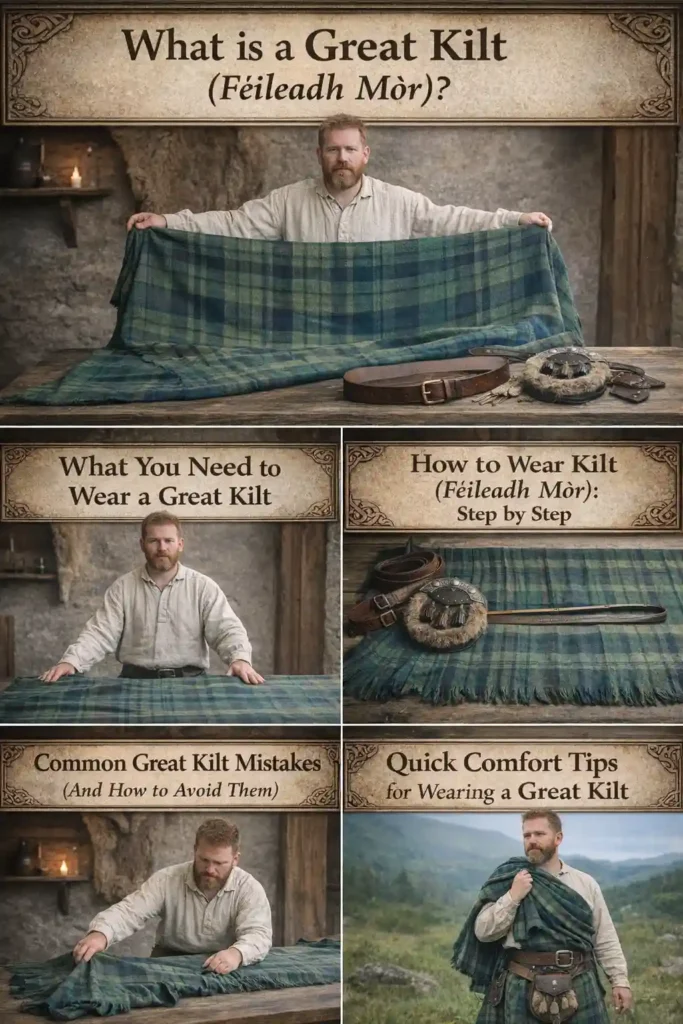
Step 1: Find a Clean, Flat Surface
A bed works. A clean floor works. I’ve used a rug and then regretted it because the fabric picked up lint—so, you know, learn from my minor mistakes.
Lay the tartan flat with the “outside” pattern facing down (so when you fold it, the good side ends up outward). If you’re not sure which side is “right,” pick the side that looks richer or slightly smoother.
Step 2: Create The Pleated Section in The Middle
This is the part that looks complicated, but it’s really just repeating folds.
- Identify the center section that will sit around your waist and hips.
- Start making hand pleats (accordion-style folds) along the width, keeping them roughly the same depth.
Two common pleating approaches:
- Pleat to the sett: the tartan pattern lines up across pleats (more precise, takes longer).
- Knife pleat / simple pleat: evenly spaced pleats without perfect pattern matching (faster, still looks great).
If you’re new, do the simple pleats. You can always get fancy later.
Step 3: Place The Belt Underneath The Pleats
Once you’ve pleated the middle section, slide your belt under the pleats (not over them yet). Center the belt so you have equal belt length on both sides.
This step feels strangely satisfying, like you’re setting the foundation.
Step 4: Lie Down on The Pleats (yes, really)
This is the classic method. You carefully lie back onto the pleated section so it’s positioned under your lower back and hips.
- The pleated portion should sit roughly where you want the kilt to wrap (waist/upper hip area).
- The unpleated ends will become your front aprons.
It feels odd the first time. You’ll wonder if you’re doing something ridiculous. You are, slightly—but it works.
Step 5: Wrap The Fabric Around Your Waist
While still lying down (or sitting up carefully), bring one side of the tartan across your front, then bring the other side over it.
You’re aiming for a wrap that feels secure but not tight. There’s a sweet spot here. Too loose and it shifts; too tight and it rides up weirdly when you stand. I think “snug, not restrictive” is the best description.
Step 6: Buckle The Belt Over Everything
Now bring the belt ends around your waist and buckle it over the fabric to lock everything in place.
Stand up slowly. Not dramatically. Just… slowly. The Great Kilt is forgiving, but it’s also honest about gravity.
Step 7: Adjust The Apron And Check The Length
In front, you’ll have overlapping layers (aprons). Smooth them down so they hang straight.
Length check:
- Traditionally, the “kilt” portion falls around the knee area (often mid-knee).
- You can adjust by raising or lowering where the belt sits.
If it’s too long, don’t panic—just reposition and re-buckle. This is one of those “it takes a couple tries” things.
Step 8: Arrange The Upper Fabric (The “Plaid” Drape)
Now you’ll deal with the extra fabric above the belt.
Common options:
- Over the left shoulder (classic): gather the top portion and drape it over your shoulder like a cloak.
- Across both shoulders: more wraparound warmth, less swashbuckling.
- Loose and flowing: looks dramatic, can slip if not pinned.
Most people do the left-shoulder drape because it’s iconic and easy.
Step 9: Pin or Brooch The Shoulder
Use a brooch or pin to secure the draped fabric at the shoulder area. This prevents the top from sliding off every time you move your arms.
A gentle caution: don’t pin through too many thick layers unless the pin is strong. Some tartans are bulky. Your pin will tell you if it’s unhappy.
Step 10: Add Finishing Accessories (optional, but nice)
This is where you make it look intentional rather than “I wrestled a blanket and won.”
- Sporran: worn front and center, hanging from a strap or chain.
- Kilt pin: placed on the lower outer apron (usually near the bottom corner).
Small note: it’s not meant to pin the whole kilt shut—more like a bit of weight and decoration. - Hose and shoes: helps balance the outfit visually.
Common Great Kilt Mistakes (and how to avoid them)
Pleats drifting As You Move
This happens. Tighten your belt a bit, and make sure the pleated section is centered and compressed before you buckle.
Too Much Fabric Bunching At The Waist
Try smaller pleats or spread them more evenly. Also, check belt placement—too high can create a bulky look.
Shoulder Drape Constantly Slipping
Use a sturdier brooch, or gather the fabric into a cleaner fold before pinning. Sometimes it slips because it’s just… messy up there. (No judgment. It happens.)
Quick Comfort Tips (because you’ll actually wear it longer)
- If it’s cold: Great Kilt wool is genuinely warm, especially with the shoulder drape wrapped across the chest.
- If it’s warm: loosen the drape, or wear it like a kilt-only wrap (some people do this; purists may sigh, but comfort matters).
- If you’re outdoors: pin the shoulder and consider a sporran. Wind has opinions.
Final thoughts: is The Great Kilt Worth It?
Honestly, yes—if you like clothing that feels alive and a little dramatic. It’s not as “set and forget” as a modern kilt, and maybe that’s the point. You have to participate in it. You fold it, adjust it, make small decisions. It feels human, in a way.
And if your pleats aren’t perfect the first time? Good. That’s normal. In fact, I kind of think the slightly-not-perfect Great Kilt looks more believable anyway.